OTR stands for “On The Run” when people text it casually – basically saying they’re busy or rushing somewhere. In privacy settings or serious talks, it means “Off The Record,” where you don’t want your words saved or repeated.
You Saw It and Got Lost
Someone dropped “OTR” in a message and you just stared at your screen for a second. Maybe your friend bailed on plans with “can’t, going OTR tonight” or you saw it in a work chat and pretended you knew what it meant. The annoying part? Three letters, like five different meanings depending on who’s typing and why. No wonder you’re here.
The Actual Vibe Behind It
When people say they’re OTR, they’re really saying “I’m disappearing for a minute and can’t explain why right now.” It’s shorthand for being swamped without sounding dramatic. There’s something almost sneaky about it – like you’re slipping away from annoying stuff (your inbox, small talk, whatever) instead of having a real crisis.
But flip it to “off the record” and suddenly it’s not playful at all. That version means what you’re about to say stays between us, no screenshots, no gossip. Totally different energy.
Where You’ll Actually See This
Most people use OTR in quick texts when they need an excuse that doesn’t require details. Your cousin might text “OTR til Sunday, family visiting” or someone in your group chat says “going OTR, phone dying anyway.” You might also see it in social media captions like “OTR adventures” or in app settings for private chats if someone is serious about privacy.
How Context Completely Changes It
Your best friend texting “OTR, see ya” feels normal and light. Your supervisor saying “let’s keep this OTR” in Slack? That’s sketchy and makes you wonder what they’re hiding. Same acronym, wildly different situations.
The jokey “on the run” thing only lands with people who get your humor. Text “OTR from responsibilities lmao” to your mom and she’ll either worry or think you’re being weird. Context isn’t just helpful here – it’s everything.
Heads up: Saying you’re always OTR makes you look unreliable. People will assume you’re dodging them specifically. And if someone goes “this is OTR” before telling you something, they’re trusting you to keep it quiet – don’t mess that up.
Times to Absolutely Skip This
Your professor won’t appreciate “sorry I was OTR during office hours.” Neither will your boss, your landlord, or anyone interviewing you for anything. It reads as immature and like you can’t communicate properly in adult situations.
Don’t use it when someone’s being vulnerable either. If your friend just shared something heavy and you reply “cool, going OTR,” you’ll sound like a jerk who doesn’t care. Match the seriousness of the conversation.
Also, stop using the “off the record” version if you don’t actually mean it. It’s not a casual joke about keeping secrets – it’s a real request for confidentiality.
Read Also: What Does WYO Mean? Meaning, Usage, and Real-Life Examples
Say This Instead
With friends:
“Swamped rn” / “Gotta run” / “Disappearing for a sec”
At work or being polite:
“Stepping out briefly” / “Tied up at the moment” / “I’ll be offline for a bit”
Being funny about it:
“Entering witness protection brb” / “Poof, gone 💨” / “Hibernating mode on”
How People Actually Use It
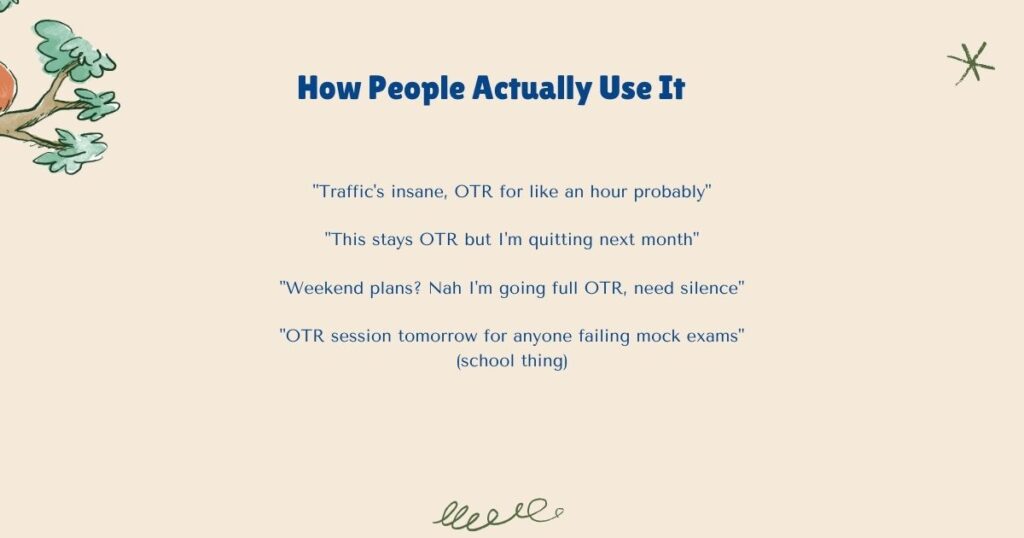
“Traffic’s insane, OTR for like an hour probably”
“This stays OTR but I’m quitting next month”
“Weekend plans? Nah I’m going full OTR, need silence”
“OTR session tomorrow for anyone failing mock exams” (school thing)
“Can’t chat, OTR from this game session” (gaming slang, optional)
“OTR til Sunday, family visiting” (casual everyday usage)
Where This Came From
The “on the run” slang got huge during pandemic times when everyone worked from home and needed quick ways to say “I’m losing it but can’t explain.” Younger crowds made it a whole mood – pairing it with memes about escaping Zoom calls or hiding from family.
Social media loves it for aesthetic travel posts, Twitter uses it when sharing info they don’t want attached to their name, and gaming also adopted it in its own way, which adds to the variety of meanings.
What People Get Wrong
Thinking OTR always means something serious or dangerous. Most of the time it just means “busy with regular life stuff, nothing wild.” It’s not that deep.
Assuming “off the record” gives you legal protection or actual security. It doesn’t. It’s just someone asking nicely for discretion. If you need real privacy, use apps built for that, not three letters in a text.
Using it constantly until your friends think you’re avoiding them on purpose. Once in a while? Fine. Every single time you talk? You’re the problem.
Read Also: What Does HG Mean? (And Why It Keeps Changing)
Real Questions People Ask
Will I sound rude saying this?
Depends who you’re talking to. Friends won’t care. Your manager definitely will.
Can I use it sarcastically?
Yeah, tons of people do. “Oh wow, so OTR from doing laundry today” – the sarcasm has to be obvious though.
Why does it mean different things?
Because acronyms are lazy and people reuse them. Medical staff, teachers, and tech people all grabbed OTR for their own stuff.
Should I ask what someone means?
If you’re confused, absolutely ask. Better than guessing wrong and either sharing something you shouldn’t or panicking over nothing.
Does age matter here?
Kind of. If you’re under 30 you probably see it all the time. Over 40? Might look like gibberish.
Bottom Line
OTR works when you need to dip out of a conversation fast without writing a paragraph about why. Just don’t overdo it or use it with people who expect actual sentences. And if someone trusts you with an “off the record” moment, respect that – it’s not about the acronym, it’s about not being a terrible person who can’t keep their mouth shut.

I’m a language enthusiast who decodes how people really talk online. On PhotoSlush, I explore slang, abbreviations, and text meanings so readers never feel lost in digital conversations. Each post blends real-world usage, culture, and clarity—making modern language simple, relatable, and actually fun to understand.