“SMT” has three lives in texting: it means something, sucking my teeth, or send me this. Which one it is depends entirely on context — there’s no universal answer.
Why This One’s Actually Confusing
Most slang terms have one meaning. “SMT” has three completely unrelated ones, and none of them look related when you read them. So when you see it in a comment or a DM, you’re left doing a little mental calculation — is this person annoyed? Do they want something from me? Or did they just type fast?
You’re not overthinking it. It genuinely could go any direction.
Breaking Down Each Meaning
“Something” is the most low-effort of the three. It’s not really slang — it’s just speed-typing. People who text fast don’t want to type nine letters when three will do. “I feel like I’m missing smt” is the same sentence with less effort. No hidden meaning, no attitude.
“Sucking my teeth” is where personality enters. It’s a real sound — that sharp little tcht people make when something bothers them, surprises them, or disappoints them. Typing “SMT” is putting that sound into text form. It’s a reaction, not a statement. When someone drops it in a comment after watching something dramatic unfold, they’re not explaining themselves — they’re just reacting.
“Send me this” is transactional and direct. It shows up mostly under content — reels, stories, posts — when someone wants what they’re seeing dropped into their DMs. “SMT the jacket” means exactly that. No subtext.
The Part That Trips People Up Most
The “sucking my teeth” version sounds way harsher in text than it does out loud. In person, that sound can be playful, almost teasing. In a text conversation without tone of voice or a face to read, it can land like a cold brush-off.
So if someone you’re not super close with sends just “SMT…” in response to something you said, it’s easy to spiral into wondering what you did wrong. Usually the answer is nothing — they’re just reacting, and text stripped the warmth out of it.
The opposite happens too. Close friends use “SMT” as basically a term of affection at this point — like “you’re so annoying” said with a huge smile. Same letters, completely different feeling.
Read also: ONB Meaning in Text: What Your Friends Are Actually Saying
When the Meaning Is Obvious vs. When It’s Not
Honestly, most of the time context makes it clear before you even finish the sentence.
- “I need to buy smt for her birthday” → something, obviously
- “SMT… he did NOT just say that” → sucking my teeth, no question
- “SMT the audio from your last video” → send me this, plain as day
The tricky cases are short one-word drops with no surrounding sentence. Just “SMT” as a reply. That’s where relationship and platform start doing the work of explaining it.
Platform Patterns Worth Knowing
Instagram and Snapchat lean heavily toward “send me this.” People see content they want, they comment fast, they move on. It’s become almost a standard shorthand there — creators know what it means the second they see it.
TikTok runs on reaction culture, so “sucking my teeth” lives comfortably in the comments. A controversial clip, a cringe moment, someone saying something that doesn’t land — “SMT” in that space is almost always an emotional response, not a request.
Regular texting is where “something” shows up most. It’s casual conversation with someone you already know, so nobody’s making big requests or dramatic reactions. Just fast, informal typing.
When You Probably Shouldn’t Use It
In any message where the relationship is still new or unclear, “SMT” as a reaction can read wrong. The person on the other end doesn’t have the context to soften it.
Work messages — even with coworkers you like — tend to get awkward with this kind of shorthand. Not because it’s offensive, but because half the people in a Slack thread won’t know what it means, and the other half will interpret it differently.
If someone’s having a genuinely hard day and you respond with “SMT,” even meaning it sympathetically, it risks reading as dismissal. A full sentence does a lot more in those moments.
And if you’re posting publicly, “SMT” as a caption or headline just looks unfinished to anyone outside of texting culture.
Alternatives That Actually Fit
When you want the “something” shortcut but SMT feels off — “smth” is a popular alternative and reads slightly clearer.
For the reaction version, “chile…” or “man…” or even just “…” carry similar emotional weight without the ambiguity. If you’re going for playful disapproval, “lmaoo stop” or “bro 😭” land the same vibe with less chance of misread.
For the send request, just typing “can you send this?” or “send pls” is more direct and nobody has to decode anything.
Read also: Sym Meaning Slang: What It Actually Means When Someone Texts You “Sym”
SMT Meaning in Text — Real Examples
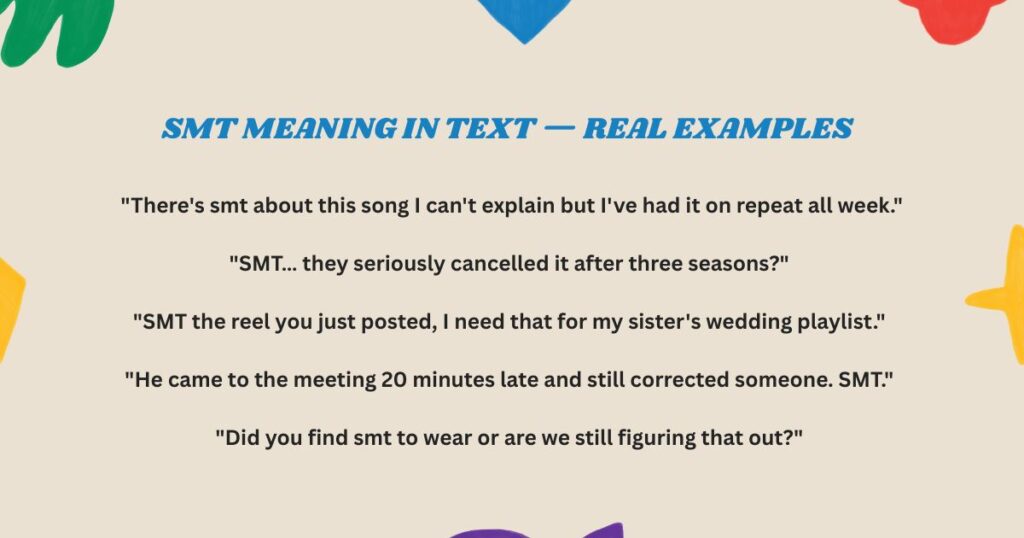
“There’s smt about this song I can’t explain but I’ve had it on repeat all week.”
“SMT… they seriously cancelled it after three seasons?”
“SMT the reel you just posted, I need that for my sister’s wedding playlist.”
“He came to the meeting 20 minutes late and still corrected someone. SMT.”
“Did you find smt to wear or are we still figuring that out?”
“SMT her confidence is everything honestly” (here it’s borderline — could be admiration or side-eye depending on who’s saying it)
“I swear I put smt in the bag and now it’s gone.”
The Gender Question People Keep Asking
Searches like “SMT meaning from a girl” or “what does SMT mean from a guy” come up a lot, and the honest answer is: the letters mean the same thing regardless. What changes is the relationship you already have with that person. If your situationship texts you “SMT that was wild” — that’s not a coded romantic signal. It’s just a reaction. The meaning lives in the conversation, not the acronym.
Misreadings That Happen More Than They Should
Seeing “smt” in a sentence and thinking someone’s subtly annoyed — when they literally just didn’t feel like typing “something” — is probably the most common mistake. The lowercase version especially tends to read as neutral shorthand, not a reaction.
The other common one: assuming “SMT” under a post means criticism. It almost never is. It means they want it.
And then there’s the overuse trap. Once people learn the term, some start throwing it into every other message. At that point it starts to read as filler, loses its punch, and occasionally confuses people who don’t know all three meanings.
Read also: What Does WYO Mean? Meaning, Usage, and Real-Life Examples
FAQs
Does SMT mean the same thing on every platform?
Not quite. The meaning shifts with how each platform is used. Instagram and Snapchat lean toward send requests, TikTok leans toward reactions, and texting leans toward shorthand. Same letters, different default.
Can it come across as rude?
The “sucking my teeth” version can, especially with no context around it. It’s worth adding a word or two so people understand what you’re reacting to, not who you’re reacting against.
What does SMT mean in a dating context?
Still just the same three options. If someone you’re seeing texts it, read the rest of the conversation for tone. There’s no romantic-specific meaning attached to these letters.
What about SMT in business or finance?
Completely different territory. In professional contexts it can stand for “Strategic Management Team” or other industry terms. Zero overlap with texting slang — just a coincidence of letters.
Is the lowercase “smt” different from uppercase “SMT”?
Technically no, but in practice, lowercase usually shows up in the middle of a sentence as “something,” while uppercase tends to appear as a standalone reaction. Not a hard rule — just a pattern worth noticing.
Closing
Three letters, three meanings, zero obvious clues — that’s “SMT” for you. Once you start reading it through context instead of looking for a single definition, it stops being confusing pretty fast. And when in doubt, just ask. Anyone who uses this term regularly won’t find that weird at all.

I’m a language enthusiast who decodes how people really talk online. On PhotoSlush, I explore slang, abbreviations, and text meanings so readers never feel lost in digital conversations. Each post blends real-world usage, culture, and clarity—making modern language simple, relatable, and actually fun to understand.