It’s slang for a younger person or someone new to something. Depending on how it’s said, it can be neutral, playful, teasing, or sometimes disrespectful. The word started in Florida street culture and now shows up everywhere — TikTok, rap lyrics, and even your cousin’s group chat.
You Heard It Somewhere and Now You’re Here
Maybe someone dropped “jit” in a comment and you couldn’t tell if it was friendly or fighting words. Or you’re watching a rap video trying to figure out if the artist just complimented or roasted someone.
The word feels coded. Like there’s an inside joke you’re not part of yet. And honestly? The vibe shifts depending on who says it, which is probably why you’re reading this instead of just guessing.
The Feeling Behind the Word
Calling someone a jit isn’t just about age. Sometimes people use it casually with no negative meaning at all — just as another way to say “young person. It’s about hierarchy—who’s got experience and who doesn’t. Picture two scenarios:
Your older sister watches you fail at parallel parking for the tenth time and goes, “Man, you such a jit.” She’s clowning you, but there’s affection mixed in there.
Now picture some random person online responding to your opinion with “okay jit.” That’s dismissal. They’re saying your take doesn’t count because you haven’t earned your stripes yet.
The word creates distance. It puts someone in a box marked “not quite on my level.” But sometimes that box is playful, sometimes it’s protective, and sometimes it’s pure disrespect.
Where You’ll Actually Hear This
Group chats move fast, and “jit” speeds things up. Instead of typing “this younger person who clearly doesn’t know what they’re doing,” someone just types “this jit” and everyone gets it.
Comments sections are loaded with it. Someone posts their 10-year-old brother’s dance moves and half the replies are some variation of “lil jit got rhythm tho.”
In real life? Cities like Miami, Atlanta, Chicago—you’ll catch it in regular conversation. Two friends see some middle schoolers trying to look tough: “These jits kill me.” It’s observation, amusement, maybe a little nostalgia for when they were that age.
Rappers weaponized it. When an artist calls someone a jit in a verse, they’re usually putting a target on blast for being new, fake, or beneath them. The Weeknd did this and had fans dissecting lyrics for weeks trying to figure out who he meant.
Reading the Room Matters More Than You Think
This is where people mess up.
Your best friend texts you “come on jit” after you lose a game: That’s trash talk between people who know each other. Roll with it.
Someone at school you barely know says it in front of others: They might be testing you or trying to establish they’re above you socially. How you respond sets a precedent.
Family gatherings: Uncles call nephews jit all the time in certain communities. It’s bonding through teasing—totally normal.
Online arguments: If “jit” comes out during a disagreement with a stranger, that’s a direct challenge to your credibility. They’re saying you’re too young or dumb to have a valid point.
Here’s what gets people in trouble: assuming it’s always lighthearted because it sounds kinda funny. It’s not. The word can cut when someone wants it to. And in text, where you can’t hear tone or see faces, you’re guessing at intent.
Watch what happens before and after the word. Someone calls you a jit then laughs and keeps talking normally? Probably fine. They call you a jit then go silent or start getting aggressive? Different story.
Places This Word Will Backfire on You
Work environments don’t care that it’s slang. Call a new coworker a jit and watch how fast things get uncomfortable. Even if everyone’s young and casual, there’s always someone who’ll take it wrong or report it.
School presentations, college essays, anything graded—leave it out. Teachers aren’t looking for street authenticity in your persuasive essay.
Talking to anyone’s parents. Just no. “Nice to meet you, Mr. Johnson, I see your jit made varsity”—absolutely not.
Public social media where employers or schools might see your name. What’s funny in a private Story can look really bad on your main feed when context disappears.
Meeting people for the first time. You don’t know their background, sense of humor, or whether they’ll find it endearing or offensive. Why risk it?
Read Also: What Does GRWM Mean? The Real Story Behind Everyone’s Favorite Getting-Ready Videos
Say Something Else Instead
When you’re joking with friends who get you: “young blood,” “rookie status,” “baby face”
When you need to be nice about someone’s inexperience: “they’re still learning,” “newer to this,” “finding their way”
When you’re annoyed but need to stay calm: “beginner move,” “amateur hour,” literally just skip the label and say what they did wrong
When you’re feeling nostalgic or sweet: “kiddo,” “little one,” their actual name with “lil” in front
How This Actually Sounds in Messages
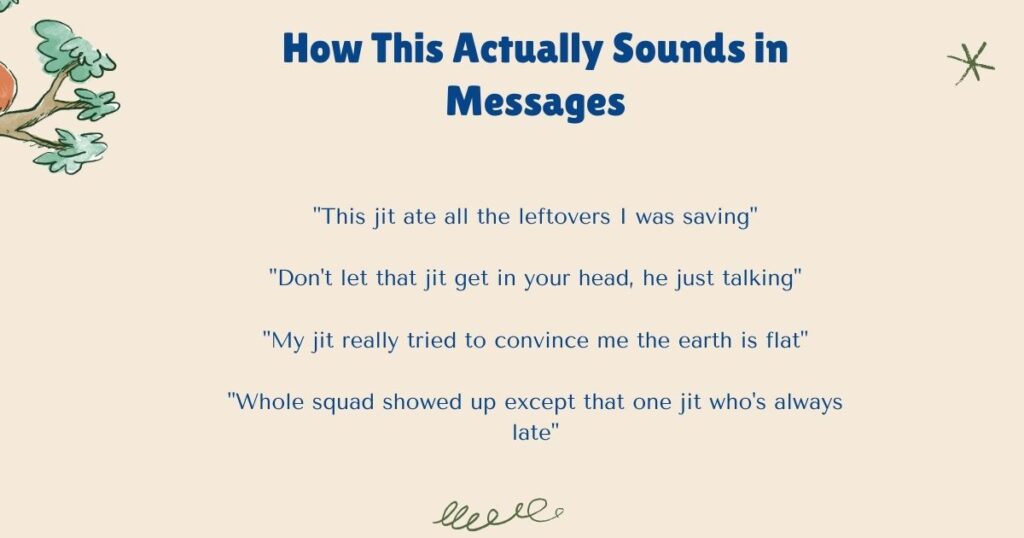
“This jit ate all the leftovers I was saving”
“Don’t let that jit get in your head, he just talking”
“My jit really tried to convince me the earth is flat”
“Whole squad showed up except that one jit who’s always late”
“She called me a jit and I still don’t know if I should be mad”
“Tell your jit happy birthday from me”
The Word’s Journey (And Why It Matters Now)
Florida’s been saying this since the ’70s—way before your parents were worried about screen time. Some say it’s short for jitterbug, those dancers who couldn’t sit still. Makes sense when you think about how kids have endless energy.
Black communities carried it through decades, mostly in the South. It stayed pretty regional until hip-hop started spreading it north and west through the ’90s and 2000s. Prison culture added layers, sometimes using it for reckless young guys who didn’t think before acting.
Then TikTok happened. Suddenly millions of people who’d never heard “jit” in their lives were watching Florida teens use it in skits. The algorithm loved it, pushed it, and boom—now it’s in Idaho, Pakistan, everywhere.
That’s actually wild when you think about it. A word that survived 50 years in specific neighborhoods went global in like 18 months because of 15-second videos.
Older people, like 40+, might not recognize it at all unless they’re from certain areas or really into hip-hop. Your parents probably don’t know it. Their friends definitely don’t.
What People Get Wrong
“It’s basically the same as calling someone kid” Not quite. “Kid” is pretty neutral. “Jit” has swagger to it, and depending on delivery, it can praise, tease, or demolish someone.
“Only certain people can say it” It came from Black communities, particularly in the South, so yeah—be aware of that history and don’t treat it like a costume you put on. But it’s also spread so far that policing who says it gets complicated. Just don’t be disrespectful about where it came from.
“JIT in my work email means the same thing” No. Your manager talking about JIT processes means Just-In-Time inventory management. Completely unrelated. Don’t get confused at the quarterly meeting.
“If I say it ironically it’s fine” Irony doesn’t land in text. You might think you’re being clever; the other person thinks you’re being a jerk.
Read Also: SNM Meaning in Text: What It Really Means When Someone Texts You “SNM”
Questions People Actually Ask
What if someone calls me this and I don’t like it?
Tell them straight up. “Don’t call me that” works. If they’re really your friend, they’ll stop. If they keep doing it, they’re not respecting you.
Does location change how people take it?
For sure. In Miami, it’s regular vocabulary. In a small Midwest town, people might not know what you mean or think you’re trying too hard to sound cool.
Can older people be jits?
Technically it’s about experience more than age, so a 40-year-old new to skateboarding could get called a jit by teenagers at the park. Would they? Probably not to their face, but behind their back, maybe.
Is it spreading to other languages?
Yeah, you’ll see it mixed into Urdu, Spanish, whatever—especially where people consume American music and social media. It gets blended with local slang for similar concepts.
Why do some people hate this word?
Same reason any slang bothers people—it feels exclusionary, unprofessional, or disrespectful depending on who you are. Plus some folks just don’t like seeing language change.
Look, words like this don’t come with instruction manuals. “Jit” works when the people around you get the reference and the relationship can handle it. It fails when you misjudge either of those things.
Pay attention to who’s talking, what just happened, and where you are. That’s really all it takes to figure out if “jit” is the right word or if you should just say what you actually mean.

I’m a language enthusiast who decodes how people really talk online. On PhotoSlush, I explore slang, abbreviations, and text meanings so readers never feel lost in digital conversations. Each post blends real-world usage, culture, and clarity—making modern language simple, relatable, and actually fun to understand.