OFN means either “On Foe Nem” — swearing something is completely true — or “Old F*ing News”** — dismissing something as outdated. Same letters, two very different vibes. Context decides which one you’re dealing with.
So You Saw It and Had No Idea
Maybe it showed up in a comment under a rap video. Maybe your friend sent it mid-argument and you didn’t want to ask what it meant. That moment of “wait, what does that even mean” is exactly why you’re here.
OFN doesn’t give you visual clues the way some slang does. It just sits there, three letters, looking confident. And because it can swing between a serious oath and a sarcastic eye-roll, even a dictionary definition doesn’t always help you figure out which version you’re actually looking at.
“On Foe Nem” — What’s Really Being Said
This one comes out of Chicago. Specifically from the drill music scene and the street culture around it.
The idea behind “foe nem” is swearing on your enemies — the people you actually clash with. It’s a strange kind of proof. You’re basically saying: even the people I’d never trust know this is real. That makes it heavier than “I swear” or “on God.” It’s got an edge to it.
When someone texts “OFN I was there, ask anybody” — they’re not being casual. They’re pushing hard on being believed. It’s the kind of phrase that shows up when regular denial isn’t cutting it, or when someone wants to lock in a promise so it actually sticks.
Lil Durk and other Chicago drill artists pushed this into mainstream vocabulary. It traveled from SoundCloud and local slang into TikTok comment sections and group chats across the country. But the weight of it still comes from where it started — it’s not a throwaway word in the communities that created it.
“Old F***ing News” — The Other Side
Completely different tone. This version is dismissive, a little snarky, and usually shows up when someone shares something that already made its rounds weeks ago.
You post a meme. Someone replies “OFN.” That’s them telling you the whole internet already saw this, and you’re late. It’s not always mean — sometimes it’s just friends being blunt with each other. But it can sting if the person genuinely thought they were sharing something fresh.
This meaning is older internet slang. Less regional, more general. The kind of thing that lived on forums and early Twitter before “On Foe Nem” started taking over the same abbreviation.
The Tone Problem Nobody Warns You About
Here’s where things get genuinely tricky.
“OFN we’re hitting that party tonight” — that’s the oath version, used for hype and certainty. It lands warm.
“That story? OFN.” — that’s a shutdown. Cold, dismissive, done.
If you’re reading a conversation and missing the tone, you can easily mix these up. Text strips out voice. There’s no facial expression attached. So the person receiving it fills in the gap with whatever mood they’re already in — and that doesn’t always go well.
Using the dismissive version on someone who’s genuinely excited about what they shared? Even if you meant it lightly, they’ll probably feel mocked. That’s the slip-up worth watching for.
When to Leave It Out Entirely
Anything professional — skip it. Work Slack, school email, formal messages, customer service, job applications. Neither meaning belongs there.
If someone’s sharing something personal or emotionally heavy, “OFN” in any version will read as cold or uncaring. Doesn’t matter what you meant.
And if this isn’t naturally part of how you talk, forcing “On Foe Nem” into your vocabulary tends to show. It’s regional slang with cultural roots. Using it to seem current, outside the context where it grew up, usually comes off as exactly what it is — someone trying it on.
Alternatives Worth Knowing
If you want to swear you’re telling the truth: “on God,” “no cap,” “I promise,” “swear on everything” — all work, all land cleaner in more situations.
If you want to say something’s outdated: “that’s old news,” “everyone knows that already,” “you’re a little late on this one” — same message, less edge, less room for misreading.
Read also: What Does ICL Mean? The Honest Guide to This Slang Term
What It Looks Like in Real Conversations
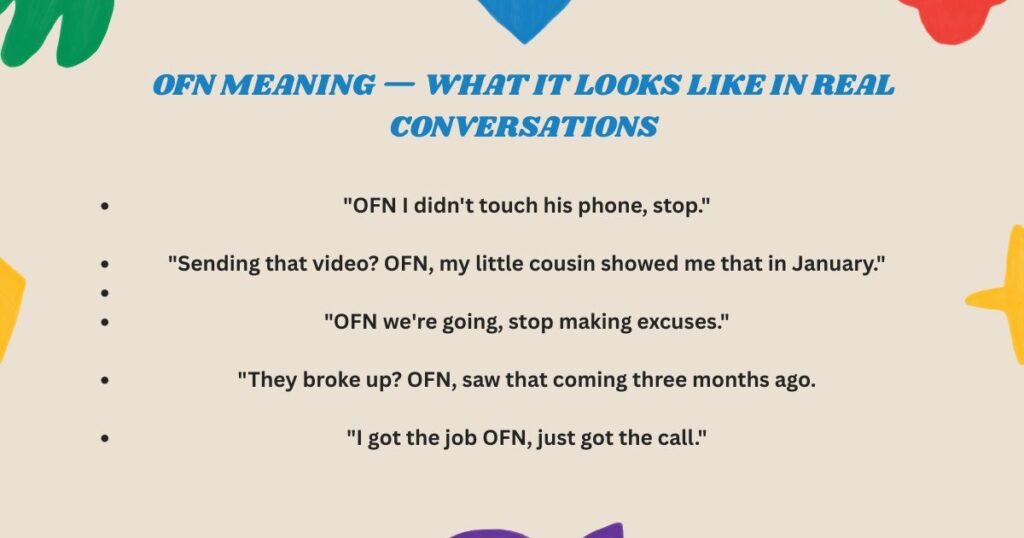
“OFN I didn’t touch his phone, stop.”
“Sending that video? OFN, my little cousin showed me that in January.”
“OFN we’re going, stop making excuses.”
“They broke up? OFN, saw that coming three months ago.”
“I got the job OFN, just got the call.”
“That beef is OFN, they squashed it forever ago.”
“OFN this is the last time I’m explaining this.”
Each one of these reads differently. Some are relief, some are pride, some are tired frustration. The abbreviation carries whatever emotion is behind it.
A Few Things People Get Wrong
Assuming it only means one thing. The oath version and the dismissal version genuinely coexist. If you only know one, you’ll misread conversations.
Overusing it. An oath means nothing if you swear on everything constantly. The phrase burns out fast when it’s everywhere.
Confusing it with OFW. That stands for Overseas Filipino Worker — completely unrelated, just looks similar at a glance.
The gaming context. In The New Order: Last Days of Europe, a strategy mod, OFN refers to the Organization of Free Nations — a faction, not slang. If you see it in that world, it has nothing to do with either meaning above.
Read Also: What Does HG Mean? (And Why It Keeps Changing)
FAQs
Does OFN mean the same thing on every platform?
Not quite. On TikTok and Instagram it almost always means “On Foe Nem.” On older forums or in gaming spaces, “Old News” is more common.
Is it rude to use?
The dismissive version can be, depending on who you send it to. The oath version isn’t rude — it just carries weight.
What’s “OFNG”?
Usually just a typo. No separate meaning, same intent as OFN.
Can people outside Chicago use “On Foe Nem”?
Technically yes. But borrowed slang always shows when it’s being performed rather than lived.
One Last Thing
OFN earns its place in a conversation when it’s used right — either backing up something real or calling out something stale. Now that you’ve got both readings in your head, you’ll catch which one it is almost immediately. That’s honestly the whole skill with slang like this. Knowing what it is gets you halfway there. Reading the room gets you the rest.

I’m a language enthusiast who decodes how people really talk online. On PhotoSlush, I explore slang, abbreviations, and text meanings so readers never feel lost in digital conversations. Each post blends real-world usage, culture, and clarity—making modern language simple, relatable, and actually fun to understand.