SMFH means “Shaking My F***ing Head.” It’s what people type when something is so ridiculous, so frustrating, or so avoidable that a normal reaction feels inadequate. Stronger than SMH. Shorter than explaining why you’re done.
Why This One’s Confusing
Most slang makes sense once you hear it out loud. SMFH is a little different because it looks almost identical to SMH — and if you don’t know what SMH means either, you’re staring at four letters with zero context.
A lot of people first see it in a comment section, or someone sends it mid-conversation and the mood suddenly shifts. You’re not sure if they’re joking or genuinely irritated. That gap between “is this playful or is this serious” is exactly why people search for it.
The Feeling Behind It
There’s a specific kind of frustration SMFH captures — the kind where you could explain yourself, but what’s even the point anymore.
Not anger. Not sadness. That particular exhaustion that comes from watching something go wrong in the most predictable way possible.
SMH is a mild disappointment. A small headshake. Like your friend forgot your order again — annoying, whatever.
SMFH is when that same friend forgot your order, blamed the restaurant, and somehow made it your fault. That’s when the “F” earns its place.
It’s not just a swear word dropped in for drama. It does real emotional work. It tells the other person: this crossed a line from annoying into genuinely unbelievable.
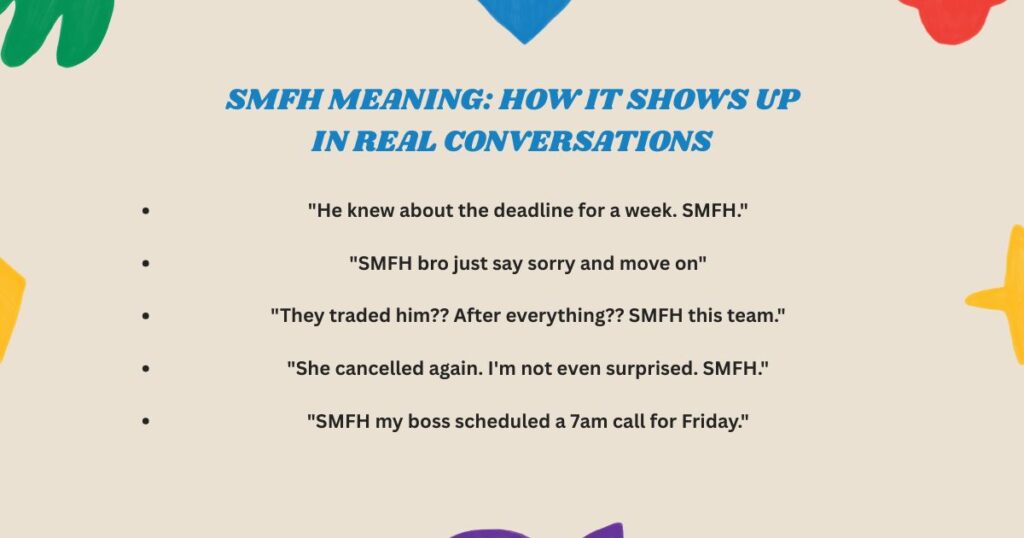
How It Shows Up in Real Conversations
It almost never comes in a long message. That’s kind of the whole point — when you’re at SMFH level, you don’t have the energy for paragraphs.
You’ll see it at the end of a sentence as a reaction stamp. Sometimes at the start, before anything else. Sometimes it’s the entire reply, standing alone.
A few real-feeling examples:
- “He knew about the deadline for a week. SMFH.”
- “SMFH bro just say sorry and move on”
- “They traded him?? After everything?? SMFH this team.”
- “She cancelled again. I’m not even surprised. SMFH.”
- “SMFH my boss scheduled a 7am call for Friday.”
- “Ordered the wrong thing, blamed the app, and left a bad review. SMFH some people.”
Notice the rhythm. Short. Blunt. No over-explanation. The frustration is already obvious — SMFH just seals it.
Read Also: What Does YNS Mean Slang ? (And Why Everyone’s Using It Wrong)
Tone Is the Tricky Part
Here’s where people get it wrong.
SMFH isn’t always rage. Between close friends, it can be affectionate teasing. In gaming chats, it’s practically a reflex after a bad play — no one’s actually devastated. In comment sections, it’s often just collective eye-rolling at something dumb someone did online.
But here’s the thing — the person reading it can’t always tell which version you meant.
If you send it to someone during a real disagreement, they’re probably not reading it as playful. If you drop it in a message about something they care about, it can land as dismissive even if you meant it lightly.
One honest warning: if you’re not close with someone, SMFH can read as aggressive. The physical image it creates — someone shaking their head at you — feels like a judgment. And in text, without tone of voice, that judgment feels sharper than you intended.
So before you send it, just ask: does this person know me well enough to read this right?
Where It Doesn’t Belong
Work communication. Full stop. Even in casual offices, even in a Slack thread where everyone’s relaxed — SMFH directed at a situation or a person can go sideways fast. The “F” alone makes it feel unprofessional in writing, even if it wouldn’t bother anyone in speech.
Also worth skipping:
When someone’s already upset and venting to you. SMFH as a response to someone’s bad news reads as dismissal — like you’re too frustrated to engage. Not the message you want to send.
Public posts where you don’t fully know your audience. It’s fine in a private group chat. On a public post, strangers don’t have your context, and some will read it uncharitably.
Talking to people who aren’t plugged into internet slang. If your aunt texts you something frustrating and you reply with SMFH, she’s either confused or offended. Neither is great.
Alternatives That Actually Work
Sometimes you want the same energy with less edge:
If you want casual but softer: SMH, SMDH (Shaking My Damn Head), or just “I can’t with this.”
If you want playful: “Bro what,” “you’re hopeless lmao,” or a facepalm emoji doing all the work.
If you need to sound like an adult in a professional setting: “That’s genuinely disappointing,” or “I’m surprised this happened again.”
None of these are perfect replacements. But they each do the job in places where SMFH would create friction.
Things People Get Wrong About It
Treating it like it always means rage. It doesn’t. Plenty of SMFH moments are low-stakes and even funny in retrospect. The intensity depends entirely on the person using it.
Using SMH and SMFH like they’re the same. They’re cousins, not twins. SMH is a shrug with mild disappointment. SMFH is you’re genuinely done.
Overusing it until it means nothing. If everything gets a SMFH — slow wifi, bad traffic, spilled coffee — it stops landing. Reserve it for when something actually earns it.
Assuming it’s always directed at someone personally. Half the time people are just venting at a situation, not accusing you of anything. If you’re unsure, it’s fine to ask.
Read Also: What Does GRWM Mean? The Real Story Behind
Related Terms Worth Knowing
SMH — the original, tamer version. Shaking My Head. Disappointment without the heat.
SMDH — Shaking My Damn Head. Lives between SMH and SMFH on the intensity scale.
SMMFH — the extreme version. Reserved for truly unhinged situations. Rare but exists.
SMF in texts — usually means “So Much Fun,” which is basically the opposite energy. Context makes it obvious.
SMFH in medical writing — an outdated term for a type of tissue tumor, now reclassified entirely. You’ll never see this outside old medical papers. Online, it’s always the slang.
FAQs
Can it be sarcastic?
Yes, and it works well that way. “Another Monday, SMFH 😒” isn’t real anger — it’s dry humor. Sarcastic SMFH usually comes with a joking tone or an eye-roll emoji nearby.
Is SMFH rude?
Depends on where you aim it. Venting about a situation — usually fine among friends. Directed at a specific person in a tense moment — it can sting more than you meant it to. Read the room.
Does it mean the same thing everywhere?
Mostly yes, though the emotional weight varies. In gaming spaces it’s almost background noise. In a personal text during a real argument, it hits very differently.
What’s AMFH?
Not widely used, but it occasionally appears as an even more exasperated variation. You’ll recognize it if you see it, but it hasn’t caught on the way SMFH has.
One Last Thing
SMFH has stuck around because the feeling it describes is genuinely universal. Everyone has that moment where something goes so predictably wrong, so needlessly sideways, that you’re just… shaking your head and walking away from it mentally.
Four letters. Loaded with context. Use it where it fits, and it lands perfectly. Use it carelessly, and it creates confusion you didn’t mean to start.
Now you know the difference.

I’m a language enthusiast who decodes how people really talk online. On PhotoSlush, I explore slang, abbreviations, and text meanings so readers never feel lost in digital conversations. Each post blends real-world usage, culture, and clarity—making modern language simple, relatable, and actually fun to understand.