TMO stands for “Take Me Out” when someone wants to hang out, or “Trying to Move On” when they’re dealing with heartbreak. In rugby, it’s the Television Match Official who reviews plays. Traffic signs use it for road orders. Which one matters depends on whether you’re reading a text, watching sports, or driving past a construction zone.
Why This Gets Confusing Fast
Picture this: your friend posts a moody selfie with “TMO” and a broken heart emoji. You’re about to comment something supportive when you notice someone else replied “Where should we go?”
Wait, what?
Three letters shouldn’t be this complicated, but TMO genuinely means different things to different people. Your ex might use it to announce they’re healing. Your coworker might use it to suggest after-work drinks. A rugby commentator uses it to explain why the ref is staring at a screen. None of them are wrong—they’re just speaking different languages with the same acronym.
The “Take Me Out” Version
This one’s straightforward but has layers. Someone typing “TMO” isn’t just requesting transportation. They’re expressing that specific restless energy when you’ve been inside too long, when your weekend’s getting wasted, when you need an excuse to put on real pants.
It’s a nudge. A “hey, I’m available and bored” signal without sounding desperate. Saying “I’m so lonely, please invite me somewhere” feels heavy. Dropping “TMO?” in the group chat feels light and casual, even though you might genuinely need the company.
Younger people especially use this when they don’t want to be the one planning everything. It’s like saying “I’ll go anywhere, just get me moving.”
The Heartbreak Version
“Trying to Move On” is what TMO means when someone’s hurting but trying to be hopeful about it. You’ll see this on Instagram Stories—that carefully chosen photo with TMO in the corner, usually posted late at night when feelings hit hardest.
It’s public vulnerability with a safety net. The acronym creates just enough distance from the rawness of typing out “I’m struggling to get over my ex and it’s harder than I expected.” TMO lets people acknowledge their pain without fully exposing it.
TikTok loves this version. Transformation videos, deleted photo montages, “healing era” content—TMO becomes the soundtrack to growing past something that hurt you. It’s become code for “I’m working on myself” in spaces where everyone understands the assignment.
Rugby’s Technical Side
If you’re watching a match and someone mentions TMO, they’re talking about the official upstairs with the replay screens. This person has one job: catch what the on-field referee might’ve missed.
Did the ball actually touch the ground for that try? Was there a sneaky elbow nobody saw? The TMO reviews, communicates with the ref, and sometimes overturns decisions that would’ve changed the game’s outcome.
Sports fans get passionate about this. When a controversial call happens and the TMO doesn’t intervene, comment sections explode. When the TMO does step in, half the fans cheer and half complain about ruining the game’s flow. It’s technical, it’s necessary, and it has absolutely nothing to do with anyone’s feelings.
How Real People Actually Use It
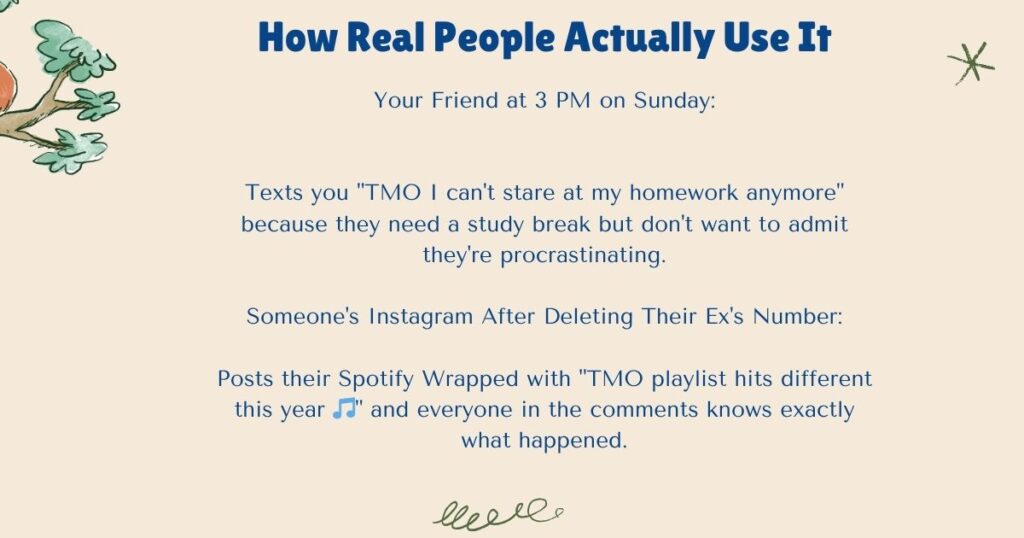
Your Friend at 3 PM on Sunday:
Texts you “TMO I can’t stare at my homework anymore” because they need a study break but don’t want to admit they’re procrastinating.
Someone’s Instagram After Deleting Their Ex’s Number:
Posts their Spotify Wrapped with “TMO playlist hits different this year 🎵” and everyone in the comments knows exactly what happened.
Rugby Twitter During a Sketchy Play:
Hundreds of people typing “TMO CHECK THAT” in all caps because they just saw something the ref didn’t.
Your Cousin in the Family Group Chat:
“Visiting your city next month—TMO to show me around?” which is sweet but also assumes you’re free.
The setting changes everything. Same letters, completely different emotional temperature.
When Tone Changes the Whole Thing
Send “TMO” to your best friend who knows you’ve been stressed? They’ll probably suggest ice cream or a drive. Send it to someone you matched with on a dating app last week? That reads like a date invitation, ready or not.
Timing matters too. Someone posts TMO at 2 AM with sad song lyrics—they’re in their feelings. Someone posts it at noon on Friday—they’re making weekend plans.
Here’s where it gets tricky: if you’re not close with someone, TMO can feel presumptuous. Like you’re assuming they have time for you or want to spend it with you. Between tight friends, it’s just efficient communication. Between acquaintances, it might need more setup.
And watch out for the breakup context. If someone just announced they’re single, flooding their mentions with “TMO let’s hang” looks opportunistic even if you meant it platonically. Let them breathe first.
Where TMO Doesn’t Belong
Job interviews, professional emails, LinkedIn messages—basically anywhere you’d hesitate to use a laughing emoji. “Should we TMO for that client meeting?” makes you sound like you’re not taking work seriously.
Don’t use it with people outside your generation unless you know they’re online enough to get it. Your boss might be 32 and extremely online, or they might be 32 and think TMO is a typo. Test the waters first.
Family chats can be risky territory. Your little cousin gets it. Your mom might misunderstand and think you’re upset about something. Your grandmother definitely thinks you’re asking her to physically drive you somewhere.
Skip it entirely if the situation’s sensitive. Someone just lost their job? Don’t hit them with “TMO to cheer you up?” It sounds flippant when they need genuine support, not slang shortcuts.
Read Also: What Does HG Mean? (And Why It Keeps Changing)
What to Say Instead
Sometimes you just need actual words:
If you want to hang out: “Free this weekend?” or “Want to do something?” works for everyone across all age groups and platforms.
If you’re healing publicly: “Taking time for myself” or “New chapter starting” says the same thing without requiring your followers to know acronym meanings.
If you’re being playful: “Bored out of my mind, who wants to rescue me?” gets the energy across with more personality.
Rugby fans don’t really need alternatives—just say “video review” if you’re talking to someone who doesn’t follow the sport.
The clearer you are, the less back-and-forth explaining you’ll need to do later.
Six Realistic Examples
Group chat on a random Tuesday:
“Work was brutal today. TMO for drinks?”
Instagram Story post-breakup:
Beach photo at sunset, text overlay: “TMO summer 2026 🌊”
Text from someone you’ve been talking to:
“So when are you gonna TMO? 😏” (The emoji makes it flirty, not desperate)
Twitter during Six Nations rugby:
“HOW IS THE TMO NOT CALLING THAT A KNOCK-ON”
Snapchat at midnight:
Black screen, white text: “tmo is harder than i thought it’d be” (Lowercase makes it feel more vulnerable)
WhatsApp from your restless sibling:
“Mom’s making me clean the garage, TMO please I’m begging”
The TikTok Effect
TikTok didn’t invent the “Trying to Move On” meaning, but it helped spread it fast because short captions and quick emotional storytelling work well on the platform. People often add “TMO” as a small text overlay or caption instead of writing long explanations.
The algorithm tends to push relatable content, so short phrases like TMO became popular because viewers instantly understand the vibe without needing full context. You’ll often see it paired with glow-up videos, post-breakup routines, or “new chapter” montages.
Hashtags also play a role. Creators use tags like #healingjourney or #movingon alongside TMO, helping the phrase circulate within specific communities. Over time, this made TMO feel less like a private message and more like a shared cultural signal.
Instagram borrowed this trend but uses it slightly differently — more polished photos, fewer raw emotional clips. Meanwhile, in regular texting, TMO still mostly means “take me out,” showing how platform culture changes meaning.
What People Get Wrong
The biggest mess-up is assuming TMO is always a question. Someone posts it as a statement about their life, and suddenly people are offering to take them places they never asked to go. Reading comprehension matters—if there’s no question mark and the vibe is sad, they’re probably not inviting you anywhere.
Another trap: thinking you need to respond immediately to every TMO you see. Sometimes people are just venting into the void. Not everything is a call to action.
People also forget that repeating the same acronym constantly makes it meaningless. If you post “TMO” every single day, your friends will stop registering it. It becomes the boy who cried wolf, except instead of a wolf it’s just you being dramatic about being bored again.
And here’s an awkward one: using TMO when you actually need serious help. If you’re genuinely struggling with mental health after a breakup, “TMO 💔” might not communicate how much support you actually need. Sometimes the full sentence—”I’m really struggling and could use someone to talk to”—is worth typing out.
Read Also: What Does WYO Mean? Meaning, Usage, and Real-Life Examples
Some Quick Answers
What if someone uses TMO and I’m not sure which meaning they mean?
Check the context around it. Emojis, timing, recent posts, your relationship with them—all of that tells you more than the letters themselves. When in doubt, just ask. “Wait, do you mean hang out or are you okay?” clears it up fast.
Can I use TMO sarcastically?
Absolutely. “Stuck in the longest meeting of my life, someone TMO” is obviously exaggerated for comedic effect. Sarcasm works best when the situation is clearly not that serious.
Does TMO sound immature?
To some people, yeah. It depends on who’s reading it. Your friends won’t care. Your professional network might think you’re not serious. Age and context determine whether it lands right or feels out of place.
Is there a difference between “TMO” and “tmo”?
Not really in meaning, but lowercase can feel more casual or vulnerable. ALL CAPS TMO usually means urgency or excitement. Proper case is neutral. It’s subtle but people pick up on these tiny tone signals.
What about TMO in other languages or countries?
English slang, mostly. It might not translate directly, but the feelings behind it—wanting to go out, trying to heal—are pretty universal. If you’re texting in Urdu or Arabic or anything else, you’d probably just spell it out in that language instead of using the English acronym.
Let’s Be Real
TMO works because context does most of the work. Instead of memorizing every possible meaning, look at who’s using it, where you saw it, and what’s happening around it. Those small clues usually tell you whether it’s about hanging out, healing from something, or sports.
If you guess wrong, it’s not a big deal. Most people will clarify quickly, and you’ll understand the vibe next time. Internet language changes fast, and learning through real conversations is part of the process.

I’m a language enthusiast who decodes how people really talk online. On PhotoSlush, I explore slang, abbreviations, and text meanings so readers never feel lost in digital conversations. Each post blends real-world usage, culture, and clarity—making modern language simple, relatable, and actually fun to understand.